Feeds:
Posts
Comments

Posts Tagged ‘Genealogy Research’

Most Puerto Rican genealogists start in the same place: civil registration records, census data, and church baptisms. Those are the right first steps. But there is a whole category of historical sources that most researchers never open, and it is sitting online, free, waiting for you.

I am talking about newspapers.

Puerto Rican newspapers published birth announcements, marriage notices, obituaries, legal notices, property transactions, and ship arrivals. They named enslaved people as being freed and freedpeople as disputing labor contracts. They published the names of militia officers, business partners, and godparents. They covered events that left no trace in official records.

And the best collections are completely free.

Puerto Rico Electoral Census (1888): Voter Lists for Rincón and Mayagüez

Why Newspapers Fill Gaps That Other Records Cannot

Civil registration in Puerto Rico did not begin until 1885. Church records go back further, but they are incomplete, hard to access, and sometimes lost. For the decades between the 1840s and 1885, newspapers are often the best source you have for finding your ancestors by name.

Even after 1885, newspapers add something civil records cannot: narrative. A death certificate tells you when someone died. An esquela (the formal death notice published in Puerto Rican papers) may tell you where they were born, what they did for a living, who their parents were, which church they belonged to, and which relatives survived them. That is a life history in a single clipping.

Legal notices in colonial papers reveal property, debt, and family structure in ways that go far beyond what a census captures. The Gaceta de Puerto Rico, the official Spanish colonial government gazette, published royal decrees, land grants, militia appointments, and slave trade records. It ran from 1806 to 1902, making it one of the longest-running and most genealogically rich newspapers in Caribbean history.

Six Puerto Rican Newspapers Every Genealogist Should Know

Gaceta de Puerto Rico (1806-1902)

The oldest and most authoritative paper on the island. As the official colonial gazette, it published government notices, legal records, property transactions, and announcements of births, marriages, and deaths. It is especially valuable for slavery research: manumission notices, runaway slave advertisements, and slave sale notices ran throughout the slavery period, which ended in 1873. After abolition, it published liberto (freedperson) labor contract disputes.

Chronicling America (Library of Congress) has 10,643 digitized issues from 1836 to 1902, fully searchable and free. Search the Gaceta de Puerto Rico

Boletín Mercantil de Puerto Rico (1839-1918)

The second most important paper of the colonial era. The Boletín Mercantil is especially rich for reconstructing the economic and social lives of ancestors connected to commerce, landholding, or elite networks. Property sales, business partnerships, and travel notices appear throughout its run. Chronicling America has 34 of 37 years in print available. Search the Boletín Mercantil

La Correspondencia de Puerto Rico (1890-1943)

Founded in San Juan on December 18, 1890 by Ramón B. López, this one-cent paper was designed to reach the general public and quickly became the largest circulating daily on the island, with a print run of 5,000 copies a day. It is considered the first daily news report in Puerto Rico accessible to a wider public. Vital notices in La Correspondencia often include detailed family information that you will not find in official records. Chronicling America holds issues from the late 1800s through the early 1900s. Search La Correspondencia

La Democracia, Ponce (1890-1948)

Founded and published by Luis Muñoz Rivera, Puerto Rican poet, journalist, and politician. La Democracia was first published in Ponce in 1890 and is valuable for political activity, community leadership, and land issues. Chronicling America has 4,244+ digitized issues from 1891 to 1907. Search La Democracia

El Mundo (1919-1990)

The major conservative daily of the 20th century, El Mundo is now fully digitized and open access. The archive covers 1919 to 1990 and is full-text searchable, making it an exceptional resource for 20th-century vital notices, obituaries, and local events. It was made publicly available through the GPA CRL Alliance, a partnership between East View Information Services and the Center for Research Libraries (CRL), funded specifically to benefit scholars and the general public at no cost. Search El Mundo

El Imparcial (1918-1970s)

Covered the political and economic impacts of U.S. control. Available through the Eastview Global Press Archive (subscription) and partially through the Digital Library of the Caribbean. Browse El Imparcial at dLOC

Free Platforms: Where to Search

Chronicling America (Library of Congress)
The best starting point for Puerto Rican newspaper research. Filter by state/territory (Puerto Rico), then by newspaper title and date range. Six Puerto Rican titles, more than 33,000 issues, 1756 to 1963. Free. chroniclingamerica.loc.gov

Digital Library of the Caribbean (dLOC)
The Caribbean Newspaper Digital Library (CNDL) holds 130+ 18th and 19th century newspapers from 22 Caribbean islands, covering 1718 to 1876. Built by a consortium of 90+ institutions including the University of Florida and Florida International University. Includes Spanish, English, and French language papers. Essential for tracking migration between Puerto Rico, Cuba, the Dominican Republic, and other islands. dloc.com

El Mundo Digital Archive
Full open access to 71 years of Puerto Rico’s major daily. Search by keyword, browse by date. No subscription required. UC Berkeley announcement with link

Archivo Digital Nacional de Puerto Rico (ADNPR)
Searchable repository of Puerto Rican archives, maps, newspapers, government gazettes, and periodicals. adnpr.net

Biblioteca Digital Puertorriqueña (UPR)
The University of Puerto Rico’s digital collections include newspapers, manuscripts, photographs, and rare books. upr.contentdm.oclc.org

Hemeroteca Digital (Biblioteca Nacional de España)
Spain’s national library has fully digitized and made searchable historical Spanish-language newspapers, including some with coverage of the Caribbean. Free. bdh.bne.es

What to Look For Once You Find the Right Paper

Once you find the right newspaper, search beyond just your ancestor’s name. Colonial and early 20th-century Puerto Rican papers published:

  • Birth, marriage, and death announcements with family details
  • Esquelas: formal death notices naming parents, spouse, children, and community ties
  • Property transfers, tax assessments, and probate filings
  • Business licenses and partnerships (many were family enterprises)
  • Guardianship appointments (which tell you there were minor children)
  • Ship arrival and departure lists (migration evidence)
  • Manumission notices and slave advertisements (pre-1873)
  • Godparent relationships (padrinos) that reveal extended family networks
  • Censo electoral para Diputados a Cortes (electoral census lists): official voter eligibility rolls for Spanish parliamentary elections, published in the colonial press

A note on electoral census lists: These rolls name voters by full name, municipality, barrio, and qualification (property ownership, income, or recognized occupation). Because voter eligibility was restricted to propertied and educated men, an ancestor’s appearance is a strong indicator of economic standing and places them precisely in a barrio at a specific date. If your ancestor does not appear, that does not mean they were not present: it means they did not meet the restricted criteria.

Search Tips That Will Save You Time

Try spelling variations. Surnames were Hispanicized, accent marks were dropped in typesetting, and transcriptions are imperfect. Search just the first three or four letters of a surname to cast a wider net.

Search for women differently. Women were often listed as “wife of [husband’s name]” rather than by their own name. If you cannot find a woman directly, search for her husband and read nearby announcements.

Browse when keyword searches fail. If you know approximately when your ancestor was alive in a particular town, browse issues from that period rather than searching by name. The context you find around other families will orient you.

Document your negative searches. If you searched a title, date range, and found nothing, write it down. A documented absence is a data point. It tells future you (and anyone reading your research) what was already checked.

Cross the colonial boundaries. Puerto Rican families moved between islands. The dLOC holds newspapers from Cuba, the Dominican Republic, and other Caribbean islands that may name your relatives in a way no Puerto Rican paper does.

Paid Options Worth Knowing

If you have a subscription, these platforms add depth:

PlatformWhat it holds
GenealogyBankPuerto Rican marriage records with biographical detail; claims 95% exclusive content
Latin American Newsstream (ProQuest)Full-text access to 41 Puerto Rican newspapers (requires university or public library card)

Start Here

If you have never used newspaper research for your Puerto Rican family, start with Chronicling America. Go to the site, select Puerto Rico as the state, and search your oldest known surname alongside the town your family came from. Spend twenty minutes browsing. You may not find your ancestor on the first try, but you will learn what the papers look like, how names were recorded, and what was happening in your ancestral town.

Newspapers do not replace civil records or church registers. They work alongside them. When the official record gives you a name and a date, the newspaper gives you the story.


*Want to go deeper? I have put together a free five-lesson mini-course on using Puerto Rican newspapers for genealogy, hosted at PuertoRicanGenealogy.org. It walks through each platform step by step, with search exercises and case studies. Check out Looking for Ancestors in Historical Puerto Rican Newspapers


© 2026 Sylvia Vargas. looking4myroots.co. All rights reserved.

Read Full Post »

If you have roots in the western side of Puerto Rico, chances are you’ve hit a wall trying to find records from the early 1800s. FamilySearch has a lot, but not everything. And some of the best records are sitting in places most people never think to look.

This week, someone in the Facebook group Sociedad Puertorriqueña de Genealogía shared something I hadn’t seen before: the Archivo Digital de Aguadilla. Free, online, and full of parish records going back to 1780. I want to walk you through what it is and how to use it, especially if you’re just getting started.

What Is the Archivo Digital de Aguadilla?

The Archivo Digital de Aguadilla is a free online archive of historical documents from Aguadilla, Puerto Rico. It was created by Haydée E. Reichard, and the heart of the collection is the Libros Parroquiales (Parish Books) from 1780 to 1843: baptism, marriage, and burial records from the parishes of Aguada and San Carlos Borromeo.

These are the kinds of records that can take you back generations before civil registration began in 1885. If your family is from the western part of the island, this archive is worth knowing.

The records have been alphabetized by surname, which makes it much easier to navigate than flipping through unindexed handwritten pages.

Browsing the Site

When you land on the site, you’ll notice it’s primarily in Spanish. Don’t let that stop you. Tools like Google Translate can help you read the navigation and any descriptions.

The site is organized into categories you can explore from the footer or sidebar:

  • Libros Parroquiales: Parish birth, marriage, and death records (this is the main collection)
  • Genealogía: Genealogical collections
  • Documentos Nuevos: Newly added documents
  • Ensayos: Historical essays
  • Other collections from researchers like Herman Reichard, Ramón Añeses, and Jaime González

Click the hamburger menu (the three lines, ≡) in the top right corner to access all sections, including Noticias, which is where they announce new additions to the archive.

How to Search

Here’s where it gets a little different from what you might be used to on FamilySearch or Ancestry. There are two ways to search, and the one that looks most obvious is actually the less useful one.

Option 1: Site-Wide Keyword Search
Go to “Buscar en Archivo Digital” in the main menu, type a surname, and click Buscar. This searches across all posts and pages on the site.

Option 2: External Archive Database (Better for Parish Records)
On that same search page, look for a link that says “BUSQUEDA”. Click it. This takes you to an external tool at archivonacional.com where the full Haydée Reichard collection is searchable as a proper database. This is the better option for finding a specific person.

Using the Parish Book Viewer

When you open one of the parish book entries, an embedded document viewer loads right on the page. It looks like this:

Inside the viewer, the records are sorted alphabetically by surname. You have a few options for navigating:

  • Use the Índice (Index) button to pull up a list of surnames and jump directly to the one you’re looking for.
  • Use “Otros Libros” (Other Books) to switch between the available volumes: baptisms, marriages, and death records across different years.

My Experience: The Search That Didn’t Work

I want to save you some frustration. When I first tried the site, I searched for “Acevedo” using the viewer’s built-in search bar. It came back with no results at all.

Search bar displaying the name 'Acevedo' with options for 'Exact match' and 'Whole words', indicating no results found.

I almost moved on. But I tried the Índice instead (again, click the hamburger menu ), and there it was: a long list of Acevedos.

A list of names and titles from a historical document dated November 19, 1814 to August 20, 1818, possibly related to individuals of 'blancos y pardos'.

The lesson: do not expect this search to work like FamilySearch or Ancestry.

  • Use the Índice.
  • Browse by letter.

The site was built differently, and once you understand that, it makes much more sense.

What You’ll Find Once You Get There

Once you locate a record, you’ll be reading handwritten text from the 1700s and 1800s. That’s both exciting and a little intimidating if you’ve never done it before.

There are no typed summaries or extracted data fields. You’re reading the original handwriting directly. A few things to keep in mind:

  • If you’re comfortable reading cursive in English, you can figure out many of the letters.
  • AI tools can help you get started with a transcription, but always verify what any AI produces by comparing it word-by-word to the original image. AI makes mistakes with old and new handwriting!
  • If you want to build your skills, the Spanish Paleography Digital Teaching and Learning Tool is a wonderful free resource designed to help people read early modern Spanish handwriting from the sixteenth and seventeenth centuries.

A Few Honest Limitations

This archive is a labor of love, not a commercial database. That means:

  • The collection is not exhaustive. Some years and volumes are missing because access to the originals was limited.
  • The site is primarily in Spanish.
  • The search tool inside the viewer does not behave like a modern search engine. Use the Índice.

For related Puerto Rico records, the Enlaces page on the site links to the broader Archivo Digital Nacional de Puerto Rico at adnpr.net, which is worth bookmarking.

One More Resource Worth Knowing

The same Facebook group also shared another resource this week: Rutgers University’s Digital Library of Historians of Puerto Rico.

This is a digital collection of books by Puerto Rican historians, including Francisco Moscoso, Fernando Picó, David Stark, and Francisco Scarcano.

If you’re not fluent in Spanish, having these books in digital form means you can use Google Translate to read them or use them as a reason to start learning Spanish. Context matters in genealogy, and these historians can help you understand what life was like for your ancestors.

Start Looking

If your family is from Aguadilla or the surrounding area, or if you simply want to push further back than civil records allow, give the Archivo Digital de Aguadilla a try. Go to the site, click on a book, and look through the index. You might be surprised what comes up.

And if you find something, share it with the community. That’s how we all move forward.

Read Full Post »

A few years ago, my Tia Vidalina gave me a box of Funeral Cards (“tarjetas de recuerdo“) from funerals she had attended over the years. Each card offered prayers and simple artwork to remember a loved one — cousins, uncles, aunts, parents, grandparents, and many others I don’t recognize but who mattered deeply to someone. To help keep this tradition alive, I returned the box with an album so she could store the collection properly. It’s a keepsake she may one day donate to a local historical society.

I scanned every card, and today I uploaded it to PuertoRicanGenealogy.org, where they can help other researchers trace their own Puerto Rican family histories. There are only 154 cards, but hopefully they will help others with genealogy research.

How the Dead Are Remembered in Rincón

In my family’s hometown of Rincón, Puerto Rico, deaths are not announced through newspaper obituaries. There are several reasons for this — the absence of a local paper, but more fundamentally, because earlier generations could not read. Both of my grandfathers were illiterate. My maternal grandfather was born in 1892 and died in 1973; my paternal grandfather was born in 1889 and died in 1985. They were farmers, and for them, education was a luxury unnecessary given the more immediate demands of tilling the soil and feeding a family.

To this day, a car with a loudspeaker drives through the streets of Rincón to announce deaths and share funeral details.

Funeral Cards are another way people preserve the memory of the dead. A card is printed for each person who passed, often with a prayer and a small image. People kept them, sometimes with a candle burning nearby, as a way to pray for the soul of the deceased or simply to hold them close. Tia Vidalina’s box represents decades of that practice — a physical archive of loss and remembrance that might otherwise disappear.

My First Wake: Cangelo Vargas, December 1968

My first experience of death and mourning came in December 1968. The head of the Vargas family in New York was my Tio Canjo — Cangelo Vargas — the oldest son of my paternal grandfather. He died on December 23, 1968, from a blood clot following surgery. He was the first person I lost.

Cangelo had come to New York with his cousins in the late 1930s. Work was scarce in Puerto Rico during the Depression years, and he took whatever jobs he could find — waiter, cook, hotel work of every kind — sending most of his earnings back to Rincón to support his father, brothers, sisters, and stepmother. In 1942, Cangelo and his cousins joined the Army after the United States entered World War II. After the war, he used the networks he had built in New York to help his brothers, sisters, and many cousins find work in the city, as employment on the island remained difficult to come by.

When Cangelo died, his body was sent back to Rincón so his father could bury him. No parent should face that, but life does not ask permission.

The Novena in Washington Heights

At the time, our family lived at 565 West 171st Street in Manhattan, and most of our Vargas and Valentín relatives were within a few blocks. That proximity made our community unusually tight, and it showed most clearly in grief.

Most families could not afford to travel to Puerto Rico for the funeral, so we held a novena — a nine-night rosary prayer — in New York. A novena was still done in Puerto Rico, but for families away from the rituals of saying goodbye to a loved one, this was the only affordable option. These gatherings were somber, but they also gave us children something we needed: the presence of family, a sense of continuity, and even, in moments, joy. Food was shared, stories were told, and the apartment was filled with people who loved the same man.

I don’t attend church regularly anymore, but I’ve never stopped finding the rosary useful. It functions for me as meditation — a ritual that quiets the mind and, when I’m far from family in Seattle, closes some of the distance. Catholic Mass in Seattle is not what I grew up with in New York. The music is different. The community is different. I miss what I knew.

Sharing What Survives

The cards I scanned from Tia Vidalina’s collection are now part of the archive at PuertoRicanGenealogy.org – Tools – Funeral Cards. Many of them belong to people I can identify within my own family tree. Others remain unknown to me, but they were known to someone, and that matters.

If you have a Funeral/Memory/etc/ Card you’d like to contribute, you can email puertoricangenealogygroup@gmail.com, and I will add it to our site’s database. If not, add it to a FindAGrave memorial page. I added one for Tio Canjo: Cangelo Vargas — FindAGrave Memorial.

These cards are small things, but they survive when people do not. I hope this collection helps someone find who they’ve been looking for.

Read Full Post »

San Juan, Puerto Rico – October 23, 2025

I attended the conference Haciendo las Américas: Routes, Journeys, and Destinations, in San Juan, Puerto Rico from Oct 23 thru 25. The Sociedad Puertoriquena de Genealogia organized the joint celebration of multiple events. These included the XXIV American Genealogy Meeting, the XIV Ibero-American Congress of Genealogical and Heraldic Sciences, and the III Puerto Rican Genealogy Congress.

The first day of the Congreso opened my eyes to the Caribbean’s rich tapestry. Migration, defense, and resilience have shaped this region. From noble title controversies to family sagas spanning continents, each presentation revealed another layer of our shared history.

Noble Titles and Genealogical Fraud

Javier Gómez de Olea y Bustinza from Madrid opened the conference with a fascinating forensic genealogy case. As Director of the Real Academia Matritense de Heráldica y Genealogía, he exposed the falsification used in 1918 to rehabilitate the title of Count of Santa Ana de las Torres. The legitimate lineage traced back to Don Nicolás de Ribera “El Viejo,” the first mayor of Lima, but somewhere along the way, fabricated documents crept into the record. Co-authored with Peruvian genealogist Mela Bryce, this presentation reminded us that rigorous documentation is essential—and that even noble titles aren’t immune to historical manipulation.

Courageous Women Crossing the Atlantic

Enrique Javier Yarza Rovira from Montevideo shared a compelling story about the founding of Uruguay between 1724 and 1730. The Spanish Crown recruited families from the Canary Islands, who arrived in two waves (1726 and 1729). What struck me most was his focus on women traveling alone in 1729, some of them heads of households. These courageous women left everything behind to build new lives in an unknown land.

His presentation sparked a personal connection for me. Enrique mentioned that ships bound for the Americas routinely picked up crew and families in Tenerife, particularly in the area of Santa Cruz. Could this explain how my family’s Barrio Cruz (now Cruces) in Rincón, Puerto Rico was settled by Canary Island immigrants? It’s a thread I’m eager to pull.

Fortifying the New World

Dr. Milagros Flores Román transported us to the 16th century with her presentation on Bautista Antonelli, the military engineer who designed the first defensive system protecting Spain’s Caribbean holdings. As Spanish territories faced constant threats from European rivals, Antonelli crafted strategic fortifications that would define the region’s geopolitical landscape. The port of San Juan emerged as a crucial defensive anchor in this system—a fact that continues to echo through the city’s historic architecture today.

From Burgos to Colombia: The Santodomingo Saga

Rocío Sánchez Del Real from Colombia shared a fascinating detective story. While researching the wealthy Santodomingo family—once Colombia’s richest—she set out to verify rumors of Sephardic Jewish ancestry. Instead, she uncovered something equally compelling: a migration route that began in 15th-century Burgos, Spain, wound through Nantes, France, contributed to Haiti’s Santodomingo Colony, survived the Haitian Revolution, and finally landed in New Granada. This wasn’t just genealogy; it was a story of migration, slavery, wealth creation, and eventual return to Europe in the 21st century. All documented through a 1577 patent of nobility from Philip II and various civil and ecclesiastical records.

Hidden Stories of Faith

Dr. Albeyra L. Rodríguez Pérez presented groundbreaking research on Judaizing individuals who migrated to the Caribbean during the 17th century. Using inquisitorial documents—causas de fe and passenger licenses—she revealed migration patterns and family networks that have received little scholarly attention. This work opens new windows into the religious and cultural dynamics of colonial Caribbean life.

The Round-Trip Journey

Professor Aníbal de la Cruz Pérez—whom I noted as “a hoot!”—shared his family’s story with both humor and wisdom. The Pérez-Gallosa family journey between the Bay of Cádiz and Puerto Rico spanned from 1750 to 2013. His presentation asked fundamental questions: Why? For what purpose? When? How? And to where should we return? After 250 years, his family made that return journey, offering valuable lessons for anyone contemplating their own genealogical pilgrimage.

Destiny or Coincidence?

Rosana Medina Peraza explored the experiences of travelers from Lanzarote who set out for one destination in the Americas and ended up in Puerto Rico by chance. Despite suffering invasions, natural disasters, and economic hardship, Canary Islanders emigrated during the 19th and 20th centuries. Notarial records reveal how they sold properties, arranged powers of attorney, and settled debts before departure—leaving paper trails that now help us understand their journeys.

Modern Tools for Ancient Roots

Arturo Cuellar González from FamilySearch demonstrated how artificial intelligence is revolutionizing genealogical research. With over 30 years of experience and degrees from BYU and the University of Utah, Cuellar showed how modern technology can help us unlock centuries-old records more efficiently than ever before.

The Royal Decree that Changed Everything

Dr. Raquel Rosario Rivera examined the Real Cédula de Gracias of 1815—arguably the most critical regulation in 19th-century Puerto Rican history. This decree catalyzed dramatic economic growth through the establishment of new plantations, businesses, sawmills, and industries. Capital investment, the influx of enslaved people, and new machinery transformed Puerto Rico’s economy.

What struck me most was how long its effects lasted. Though officially limited to 15 years and supposedly repealed in 1836, the decree’s influence extended until 1851, and land grants continued until 1875. For 37 years, it remained essentially unchanged, fundamentally reshaping Puerto Rico’s landscape. I learned about “Baldío” land—an inaccessible, uncultivable territory that was nevertheless “given” under the decree’s provisions.

Looking Ahead

Day 1 left me energized and full of questions. The connections between the Canary Islands and Puerto Rico, the hidden stories of religious minorities, the economic transformations of the 1815 decree, and the exposure of genealogical fraud—each presentation opened new avenues for exploration.

Day 2 was also exciting with more discoveries as the congress continued. For anyone tracing Caribbean roots, this gathering proves invaluable: it’s not just about finding names and dates, but understanding the forces—economic, political, religious, and personal—that shaped our ancestors’ choices and journeys.

Stay tuned for Day 2 highlights…


Conference Details:

Resources Mentioned:

Connect with Speakers:

Read Full Post »

My husband recently got boxes of photos from his aunts who want to pass on the memories to the family. They are in their 80’s and 90s. They did a great job of annotating in the back of the photos with the year and who was in the photo.

It inspired me to look at photos I have scanned (and hundreds in need of scanning) and realized I need a better way of documenting these family treasures and how to share them with the family.

This is what I did:

  1. Created a folder in my google drive. I called it RinconForest. More on that in another post.
    You can create cloud drive using Apple’s iCloud or Microsoft’s OneDrive.
    If you want to learn more about the other free/low-cost cloud drive options, leave a comment and I will post on it.
  2. I uploaded a folder of pictures to the drive. It was a very easy drag-and-drop experience.
  3. I created a google sheet document with the link to the photo and other information. See below on Photo Inventory Spreadsheet.

Google Drive with photos uploaded

If you have a gmail account, here are instructions on Upload files and folders to Google Drive.
Dont have a gmail account? See Create a Google Account


Photo Inventory Spreadsheet

My intention for the spreadsheet was to not only remind me of what’s in the photo but also provide context to younger generations of the photos.

The following screenshot of the spreadsheet I created has

  • Link to the photo in google drive
  • Description of photo with information on where and who is in the photo.
  • Year or approximate year of the photo
  • Location- city/town where the photo was taken
  • Link to google maps as to the approximate location of the photo.

Spreadsheet for photo inventory in directory

What’s Next?
I am going to update the spreadsheet with all the picture name/location into the spreadsheet. I have an idea of using my technical skills to automate this.

I realized that I can add a description on the photo in google drive as well. Maybe do that first?

Enlist my family to update the photo/spreadsheet with memories and information.

Read Full Post »

It’s been a very LONG time, since I have blogged here (or any where).

Now that I have time, I have found some great resources for my fellow boricuas in Puerto Rico or elsewhere.

  • https://boricuagenes.com – Luis Ariel Rivera’s site is full of information for genealogists old and new. Luis has a wonderful YouTube presentation Getting Started with Puerto Rican Genealogy. Check it out.
  • https://genealogiapr.com/ – The portal of the Sociedad Puertorriqueña de Genealogía (aka – Puerto Rican Genealogy). Most of its members are in Puerto Rico and have several events and meetings a year on the island. They mentioned on the website that they are recording meetings for members. The membership is currently $50/year. I just renewed my membership and will be checking out their online resources for members.
  • https://puertoricangenealogy.weebly.com – Interesting blog with some links to well know resources.
  • https://archivespuertorico.com/- Just ordered some document from Aguada. I have recently discovered some of my ancestors had moved to Rincon from Aguada. The search continues.
  • Facebook Group: Puerto Rican Genealogy – This a private group you need to request to enroll.
  • Internet Archive – Has a genealogy section with books and digitized access to the US Census including that of Puerto Rico – 1910-1940. I did not see a search feature in the US Census images, it is a good way to scan for free a town to look for ancestors.
  • https://www.familysearch.org – I have used quite a bit over the last 5+ years when I discovered they have a LOT of Puerto Rican images for not only the US Census, but also Birth, Marriage, and Death records and more. Please note, some records from some towns have been lost due to hurricanes, fires, and general decay. But you don’t know that till you look. Creating an account is free. I used the site to download images and information for my records.

Read Full Post »

I am fortunate to have many friends that helped me and guided me in this journey called life.  Jeanne was my second mom, or as my mother called her my Seattle Mom.

When I first met Jeanne, in the late 1980s, she spoke about her time “in camp” as a child and some of the very common happy child memories she had with her brothers and friends.  Being a kid from Spanish Harlem and the Bronx, I was impressed and slightly jealous that this older woman, born and raised in Seattle, had the benefit of going to “summer” camp and here was yet another example of how bad my childhood was in comparison.

Then the opportunity of understanding my ignorance came to bear.  Jeanne was referring to her experience in Japanese American Interment camps during the second World War.  I called my siblings and friends asking them if I had missed class the day this topic was discussed this in school (I only had missed school for one week and that was in June 1969.  Other than that I had perfect attendance from kindergarten through high school.).  To my relief and embarrassment, they too had not heard about internment.  I refer to this as the East Coast-West Coast divide of World War II.   For geographic and societal concerns, the east coast was concerned about Germany and the west coast was focused on Japan, especially after the bombing of Pearl Harbor.

The reason Jeanne had started talking about camp, was a discussion of the reparations and the redress movement that was reaching a milestone with the Civil Liberties Act of 1988.  Both Jeanne and her husband were personally not in favor of the redress money that was later distributed in 1990.  “We were at war. Our country did what they had to do.”  Jeanne would say.  I learned of her family’s good fortune for their neighbor purchasing their home for $1 right before she, her families and many others of Japanese descent were bused to Puyallup to Camp Harmony and how that family kept their home safe for their return in 1945.  There were also painful stories of the ignorance of hatred and discrimination of her, her family and friends in the Japanese community as well as many of courage, true friendship and perseverance.

I celebrated Jeanne’s birthday a few weeks ago with her son.   She would have been 78.  Her birthday inspired me to do some research that I am sharing with her nieces and nephews.  I found  interment records on Ancestry.com’s
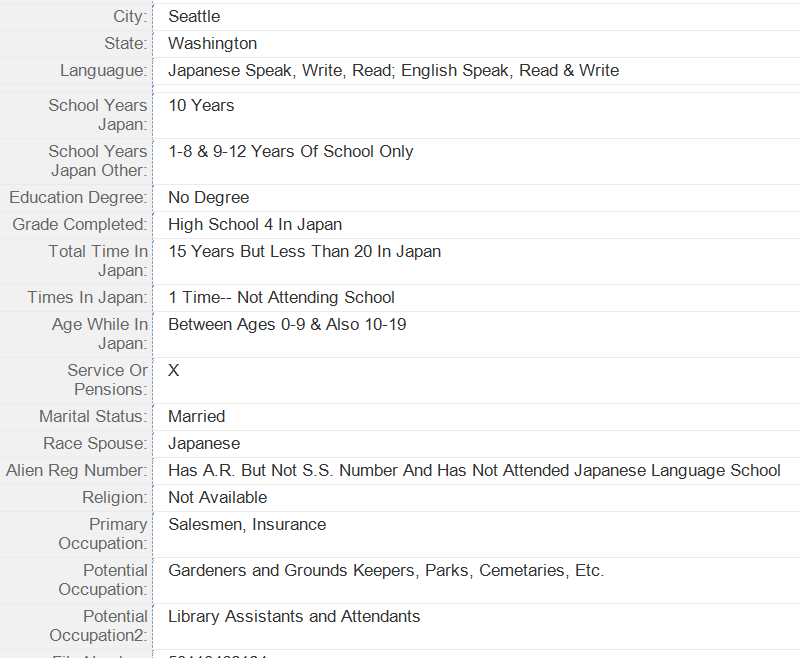
World War II Japanese-American Internment Camp Documents, 1942-1946.

Looking through the records, I was struck by the fact that they did not have family information like that of the US Census.   These records are very much like prison records and how the system was deciding the future employment of the individual (see Potential Occupations in the sample Internment record below)

I found a number of Japan born residents, survivors of the American Internment camps who became American citizens in the mid-1950s.  I assume the Immigration and Nationality Act of 1952 helped facilitate the naturalization process for them.

Jeanne and my mom spent a lot of time together in New York and Seattle on visits.  They loved discussing gardening, cooking and “Sylvia Stories”.

Gaman is the Japanese term for perseverance. Both of my moms are my role models of Gaman, and I strive everyday to do them proud.

Read Full Post »