I am planning to attend the RootsTech conference online. I have never attended the conference in-person or online, but I have reviewed the conference videos.
What is Roots Tech?
RootsTech is an annual genealogy and family history conference that provides free global family history events held virtually and in person. It provides everyone of all ages with learn to discover, share, and celebrate their family connections across generations and different cultures using technology.
The event is FREE online as well as at the conference pass in person conference in Salt Lake City, Utah, costing $109/3-day pass or $69/1-day plus travel and hotel.
In our quest to find our ancestors, we are perplexed at times as to why did they move. What affected their choices?
Years ago I found an article “Discover the “why” behind your ancestor’s choices”. The article referenced a good how-to research tip on history (see 20 Timeless Genealogy Research Tips) and how to create a timeline to align with your ancestor’s journey.
From an American experience, the Civil War (1861-1865), World War I (1914-1918), Great Depression (1929-1939) , World War II (1939-1945), Korean War (1950-1953), Vietnam (1955-1975) are some of the key historical events that shaped the experience of our ancestors in the United States and abroad.
In addition, the following events are what I believe affected my Puerto Rican ancestors’ lives.
Hurricanes. Most notable was 1899 San Ciriaco Hurricane. U.S. Army Major Albert L. Myer described the hurricane as “more disruptive to Puerto Rican society than was the American invasion.”[10] The San Ciriaco hurricane was described as the first major storm in Puerto Rico since the 1876 San Felipe hurricane. Official estimate of 3,369 fatalities. Approximately 250,000 people were left without food and shelter. Note that in the 1899 Puerto Rican census, the island population was 953,243( Wikipedia – 1899 Puerto Rican Census). So over a quarter of the island’s population was affected by death and many cases famine.
Mi Tios (My Uncles): Journey to New York and becoming “American”
My Tio Cangelo Vargas y Caro arrived in New York City by ship on April 1, 1937 (no joke!).
Canjo was instrumental in leading the way for many in our family to New York. He helped many, but I want to call out the two other New York patriarchs in my family, my Tios Juan Valentin y De Jesus, and Flor Valentin y De Jesus.
The following is the earliest listing I have discovered when my Tio Juan arrived in New York on April 23, 1938,
Both Cangelo and Juan enrolled in the US army as cooks in the second world war. Later in the Korean War, Tio Flor served in the army as well. After the war, they all owned restaurants in the garment district and Spanish Harlem.
Other uncles and cousins were inspired by them and enrolled in various branches of the US military. Like all Americans, they all have their qualms about war and its struggle, but I am proud and grateful for their service.
What brought my uncle Cangelo to New York?
My guess was to get work to rise his family from the poverty his immediate family was experiencing on the island especially in the middle of the Great Depression. His father (my grandfather) was a very good man, but he was a subsistence farmer.
With annual hurricanes, growing population on the island that literally could not feed themselves, with over 50% imports into the island was for food.
My uncles Cangelo, Juan, and Flor positively impacted my life and the lives of our extended family on the US mainland as well as on the island of Puerto Rico. I personally have had more opportunities having been born and raised in NYC. I have a great education and blessed with a great career from their being my role model through their strong work ethic and the strong family community they created in New York. They were and are foundational to a very strong “New York Puerto Rican” family that I am very proud and honored to be part of.
— What world events changed the course of your ancestor’s journey? —
In one of the many genealogy groups I belong to, there was a discussion about finding their Puerto Rican ancestors in Hawaii.
I always knew about the migration to Hawaii for sugar cane workers. My maternal grandfather grew sugar cane in Rincon, Puerto Rico, so I have been always interested how sugar cane affected the lives of my ancestors, but I now I was curious as to what documentation was available as to the cause and the journey of the Hawaiian Puerto Rican experience.
I have come to learn that the migration of Puerto Ricans to Hawaii was a result of several factors.
1899 San Ciriaco Hurricane. U.S. Army Major Albert L. Myer described the hurricane as “more disruptive to Puerto Rican society than was the American invasion.”[10] The San Ciriaco hurricane was described as the first major storm in Puerto Rico since the 1876 San Felipe hurricane.
At the time it was the worst tropical cyclone in Puerto Rico.
Approximately 250,000 people were left without food and shelter. Note that in the 1899 Puerto Rican census, the island population was 953,243( Wikipedia – 1899 Puerto Rican Census). So over a quarter of the island’s population was affected.
Overall, damage totaled approximately $35.8 million, with over half were losses inflicted on crops, particularly coffee.
At the time, it was the costliest and worst tropical cyclone in Puerto Rico.
The number of fatalities ranged from 3,100 to 3,400, with the official estimate being 3,369.
More Hurricanes
Two years later in 1901, Tropical Storm San Vicente hit the island.
The center of this tropical storm moved over the north coast of Puerto Rico in a westerly direction with estimated sustained winds of 60 mph during the night of September 11th and early morning of September 12th 1. The wind report from San Juan was of 52 mph and a pressure of 29.89 (1012 mb). The storm affected all the crops in Puerto Rico, specially the citrus.
Resources and References
Here are some sources I used to learn about the hurricanes in Puerto Rico. I am sure there are more to find and read.
My husband recently got boxes of photos from his aunts who want to pass on the memories to the family. They are in their 80’s and 90s. They did a great job of annotating in the back of the photos with the year and who was in the photo.
It inspired me to look at photos I have scanned (and hundreds in need of scanning) and realized I need a better way of documenting these family treasures and how to share them with the family.
This is what I did:
Created a folder in my google drive. I called it RinconForest. More on that in another post. You can create cloud drive using Apple’s iCloud or Microsoft’s OneDrive. If you want to learn more about the other free/low-cost cloud drive options, leave a comment and I will post on it.
I uploaded a folder of pictures to the drive. It was a very easy drag-and-drop experience.
I created a google sheet document with the link to the photo and other information. See below on Photo Inventory Spreadsheet.
My intention for the spreadsheet was to not only remind me of what’s in the photo but also provide context to younger generations of the photos.
The following screenshot of the spreadsheet I created has
Link to the photo in google drive
Description of photo with information on where and who is in the photo.
Year or approximate year of the photo
Location- city/town where the photo was taken
Link to google maps as to the approximate location of the photo.
Spreadsheet for photo inventory in directory
What’s Next? I am going to update the spreadsheet with all the picture name/location into the spreadsheet. I have an idea of using my technical skills to automate this.
I realized that I can add a description on the photo in google drive as well. Maybe do that first?
Enlist my family to update the photo/spreadsheet with memories and information.
https://genealogiapr.com/ – The portal of the Sociedad Puertorriqueña de Genealogía (aka – Puerto Rican Genealogy). Most of its members are in Puerto Rico and have several events and meetings a year on the island. They mentioned on the website that they are recording meetings for members. The membership is currently $50/year. I just renewed my membership and will be checking out their online resources for members.
https://archivespuertorico.com/- Just ordered some document from Aguada. I have recently discovered some of my ancestors had moved to Rincon from Aguada. The search continues.
Internet Archive – Has a genealogy section with books and digitized access to the US Census including that of Puerto Rico – 1910-1940. I did not see a search feature in the US Census images, it is a good way to scan for free a town to look for ancestors.
https://www.familysearch.org – I have used quite a bit over the last 5+ years when I discovered they have a LOT of Puerto Rican images for not only the US Census, but also Birth, Marriage, and Death records and more. Please note, some records from some towns have been lost due to hurricanes, fires, and general decay. But you don’t know that till you look. Creating an account is free. I used the site to download images and information for my records.
I am fortunate to have many friends that helped me and guided me in this journey called life. Jeanne was my second mom, or as my mother called her my Seattle Mom.
When I first met Jeanne, in the late 1980s, she spoke about her time “in camp” as a child and some of the very common happy child memories she had with her brothers and friends. Being a kid from Spanish Harlem and the Bronx, I was impressed and slightly jealousthat this older woman, born and raised in Seattle, had the benefit of going to “summer” camp and here was yet another example of how bad my childhood was in comparison.
Then the opportunity of understanding my ignorance came to bear. Jeanne was referring to her experience in Japanese American Interment camps during the second World War. I called my siblings and friends asking them if I had missed class the day this topic was discussed this in school (I only had missed school for one week and that was in June 1969. Other than that I had perfect attendance from kindergarten through high school.). To my relief and embarrassment, they too had not heard about internment. I refer to this as the East Coast-West Coast divide of World War II. For geographic and societal concerns, the east coast was concerned about Germany and the west coast was focused on Japan, especially after the bombing of Pearl Harbor.
The reason Jeanne had started talking about camp, was a discussion of the reparations and the redress movement that was reaching a milestone with the Civil Liberties Act of 1988. Both Jeanne and her husband were personally not in favor of the redress money that was later distributed in 1990. “We were at war. Our country did what they had to do.” Jeanne would say. I learned of her family’s good fortune for their neighbor purchasing their home for $1 right before she, her families and many others of Japanese descent were bused to Puyallup to Camp Harmony and how that family kept their home safe for their return in 1945. There were also painful stories of the ignorance of hatred and discrimination of her, her family and friends in the Japanese community as well as many of courage, true friendship and perseverance.
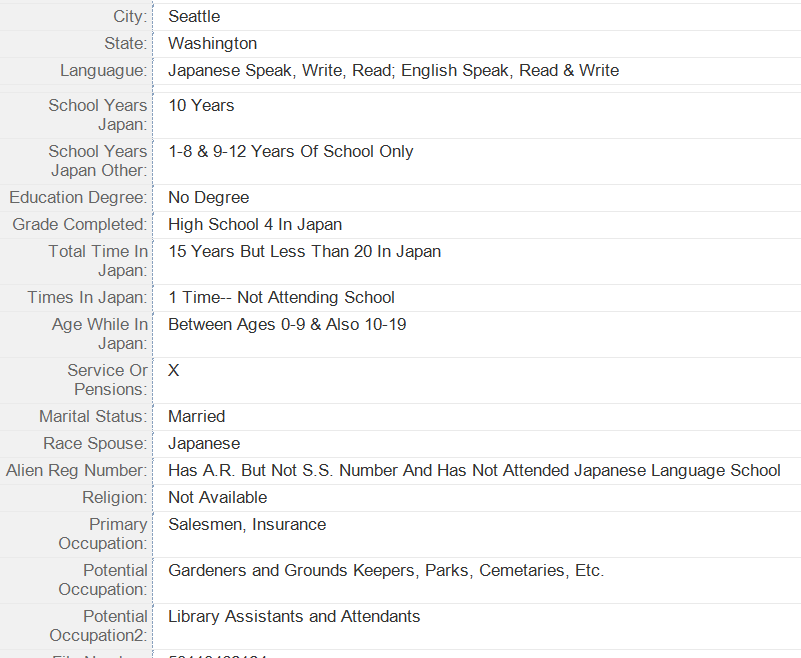
I celebrated Jeanne’s birthday a few weeks ago with her son. She would have been 78. Her birthday inspired me to do some research that I am sharing with her nieces and nephews. I found interment records on Ancestry.com’s World War II Japanese-American Internment Camp Documents, 1942-1946.
Looking through the records, I was struck by the fact that they did not have family information like that of the US Census. These records are very much like prison records and how the system was deciding the future employment of the individual (see Potential Occupations in the sample Internment record below)
I found a number of Japan born residents, survivors of the American Internment camps who became American citizens in the mid-1950s. I assume the Immigration and Nationality Act of 1952 helped facilitate the naturalization process for them.
Jeanne and my mom spent a lot of time together in New York and Seattle on visits. They loved discussing gardening, cooking and “Sylvia Stories”.
Gaman is the Japanese term for perseverance. Both of my moms are my role models of Gaman, and I strive everyday to do them proud.
I know the thought of walking through cemeteries creepy for some. But for me when I visit the town cemetery of my family’s home town, it is a very venerable place.
I remember the first time my mom took us to the town cemetery, she told us it was a place to visit and respect our ancestors. At the age of 9, I was first introduced to the concept of the modern sarcophagi. She didn’t use those terms, but the walk thru the cemetery reminded me of a couple of scenes from the Abbot and Costello movie “Meet Frankenstein” with one scene where Lou Costello is overly anxious by the cemetery (or at least that is my memory of the movie). Our family home town’s cemetery (and many countries I later discovered) was filled with above ground tombs and crypts, where in modern times a casket is placed into. The tomb structures are made of granite and can be inscribed or decorated with sculpture/adornment.
In the 1960s, given the fact the town was of humble means, the ornate tombs and statutes surprised me. Whether it was the catholic traditions or pride, it was obvious the families spent what little wealth they had on the memory of a beloved; it made quite an impression on me. I knew for a fact that many of these families were very poor. The “affluence” disparity between the living and the residence of the cemetery both saddens me and brings me solace every time I visit. Genealogy constantly reminds the resilience of the human spirit.
I recall when I visited the tombstone of my Tio (uncle) Canjo, there is was a large painting of him and his brother Gaspar at the head of the tombstone. Tio Gaspar had died over 25 years earlier in New York. Years later, at the bequest of my aunts, my research discovered Gaspar’s remains in a pauper’s tomb in Queens, NY. Tio Canjo was the eldest of the Vargas clan. His death in 1968, caused much pain and sorrow to all but especially my grandfather. Tio Canjo was the family patriarch in New York for the Vargas family. Since his passing in 1968, his loss is still felt by many in the family.
As I became passionate with my genealogy research, I took several photos of headstones with family names that resembled my family list. I discovered that my father had a number of cousins that served in the second world war. My mom confirmed my discovery as well as told me that Canjo and his cousins enlisted together when they lived in New York in the 1940s and worked as waiters and busboys.
I also discovered my mom’s maternal grandparents resting place in the cemetery. This surprised me since I knew of the stories of how my other great-grandparents were buried in the back yard of my grandparent’s or their siblings home. No head stone. No marker. So knowing that my great-grandmother Justa Silva was buried in 1948 in the town cemetery made her ‘quite’ privileged for the time.
Years later, my maternal grandmother was to be buried here alongside her parents and sister. In 2008, we brought our mom’s remains to rest here as well.
For me cemeteries hold the memories of our families. I am finding meaning and purpose understand who they were, who they loved and how they lived and share their stories to my family.
Looking for my roots is more than just finding names to place in a pedigree chart or finding the exotic lands they were from. It is a way to celebrate our ancestors’ journey and to learn the lessons they provide us for own personal journey.
Don’t get me wrong, I cherish the adventure of adding one more name to the tree or to find one ancestor (or should I say any ancestor) that was not born in the town of Rincon, Puerto Rico. But as my relatives age (as do I), I relish the stories and pictures of what was important to them. Here are some photos of my family and some of the lessons and values they have given me.
Family – As our family migrated to New York in the 1940s and 1950s, being together to celebrate any occasion was important. The birth of a child, a religious festival or ceremony (being Catholics specific celebrations included baptism, communion and confirmation), weddings and deaths are all common events in the human experience. But seeing who are present and who are not in the photos is just as important. Photos also illustrates the customs as well as the fads. I have a photo of my mom in a poodle skirt that I cannot share due to fear of eternal damnation 🙂.
The calendar of Jesus and the last supper (upper right hand side of the photo) is an important artifact as any. [Now if I can only see the source of the calendar. A local church perhaps?]
Children – This is a photo of my cousins in Puerto Rico in 1960 in front of the cake for my baptism. Looking at this photo tells me a lot of their personalities (Who is shy? Who is a ham?) The house is my maternal grand parents home, a very simple wood home. In the upper left side a picture of Jesus Christ, a sign of a religious house hold.
Food – A Puerto Rican celebration would not be complete without arroz y gandules (rice and pigeon peas) and pernil (roast pork shoulder). The wallpaper is classic of a 1950s kitchen apartment in New York (Spanish Harlem specifically), while my aunt’s sheepish and proud grin juxtaposed to my uncle’s (her brother-in-law’s) smile is true to their nature and personality. He, a very jolly and generous soul. She always ready to reply with zinger.
To me these photos show me the true joy in their lives: family, children and food. I have learned that I need to do some more celebrating.




You must be logged in to post a comment.