I searched for Acevedo in a nineteenth-century issue of the Gaceta de Puerto Rico. Nothing useful appears.
Then, while reading the pages, I spot the family as Acebedo.
The record was there all along. The search just could not lead me to it.
Most of us have had some version of this experience. When I search in Ancestry or FamilySearch, I type a surname and judge the whole collection by what comes back. When the results are empty, it is all too easy to decide the record is not there and move on.
At our July meeting, the Puerto Rican Genealogy Group discussed what we actually do when a family line stops moving. Nearly every technique shared around the room came back to the same idea:
Stop searching for your ancestor. Start reading the place.
Why Your Name Search Fails
There Are Two Layers of Noise
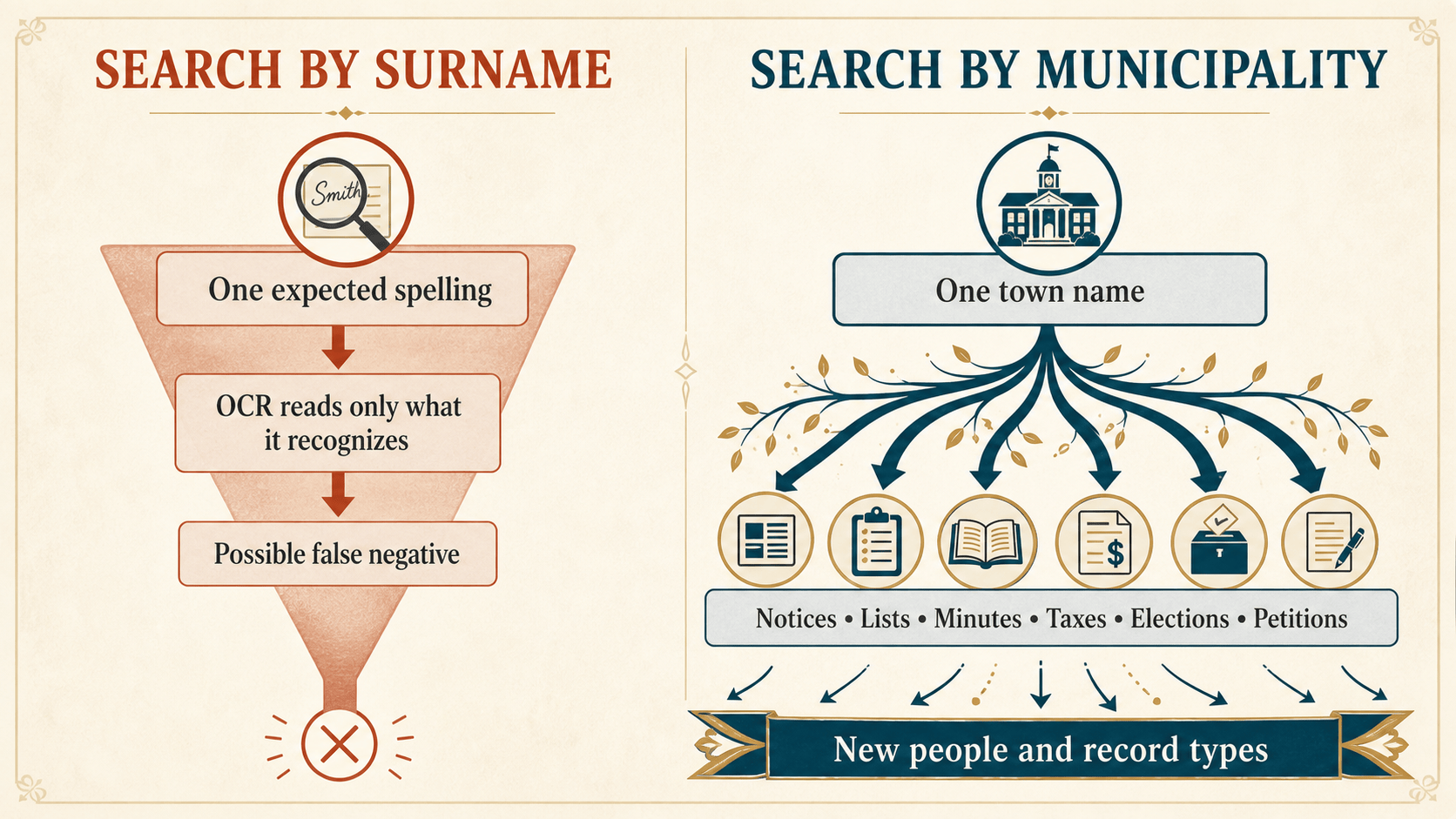
Nineteenth-century Spanish-language newspapers such as the Gaceta de Puerto Rico are searchable only by what the typesetter put on the page—and then only by what optical character recognition, or OCR, managed to read from a scan made available roughly 180 years later.
That puts two layers of noise between you and your ancestor before you type a single letter.
Surnames also appeared in forms that may look unfamiliar to us now. Acevedo might appear as Acebedo. Printers and clerks did not always apply modern spelling consistently; the letters b and v could be used differently, and accents might disappear in print.
Then OCR can misread either spelling yet again. A search for Acevedo may sail past every Acebedo on the page—and the empty result does not prove that the name is absent.
Town Names Give You Another Way In
A search for the municipality avoids some of those problems.
Town names appeared constantly in headings, datelines, official notices, and the recurring lists printed in colonial newspapers. They were often more consistent and more visually prominent than personal names.
Search the town, and the newspaper begins to open up.
Here is the difference:
Why Slow Browsing Works
Reading a town’s newspaper coverage without one specific target is slower. That is precisely why it is worth doing.
You cannot search for a record type you do not know about.
That is the quiet failure of keyword research: it returns only the things you already thought to ask for. Browsing an issue from front to back is how you discover unfamiliar kinds of lists.
Records You Would Never Think to Search For
These newspapers carry lists most of us would never put into a search box. Among them are rosters of electores, people legally qualified to participate in elections under the rules of the time.
Those qualifications changed over time and must be interpreted under the law governing the particular list. Depending on the period and office, eligibility could be shaped by sex, age, legal status, property, income, taxation, race, literacy, or other requirements.
An electores roster is therefore not a population list. It identifies the people the colonial government recognized as eligible under a restricted legal system.
If an ancestor appears, you can place him in a specific municipality on a specific date. The list may also point toward property, tax, income, or other qualifying records. You should confirm the exact legal qualification before drawing that conclusion.
If he does not appear, you have not proved that he lived there. You have only learned that the search failed to identify him on that particular restricted list.
A Negative Search Finding Is Not Automatically Negative Evidence
Both outcomes belong in your research log, but they do not mean the same thing.
An unsuccessful search is a negative search finding: you looked in a stated source, using a stated method, and did not locate the person.
It becomes negative evidence only when the absence is meaningful. You must first establish that the record should have named the person if your research hypothesis were true.
For example, absence from a complete local tax roll might matter if other evidence says the person owned taxable property there that year. Absence from a restricted electores list tells you much less unless you can show that he met the legal qualifications and should have appeared.
Record the absence. Record how you searched. Then decide whether the source was expected to contain the name.
A Manageable Mystery From March 1836
Browsing also turns up puzzles worth pursuing, and I would like to present one to you.
The March 10, 1836, issue of the Gaceta carries a list titled “Relación de los individuos del batallón de milicias 3º de Puerto-Rico y aforados de sus cuarteles que han contribuido voluntariamente para la guerra que se sufre en la Península, por una vez.”
This document names men across several municipalities, including Rincón and Añasco, who made a one-time monetary donation toward the First Carlist War in Spain. Who were these individuals, and what did this militia affiliation and contribution signify for their status in the local community?
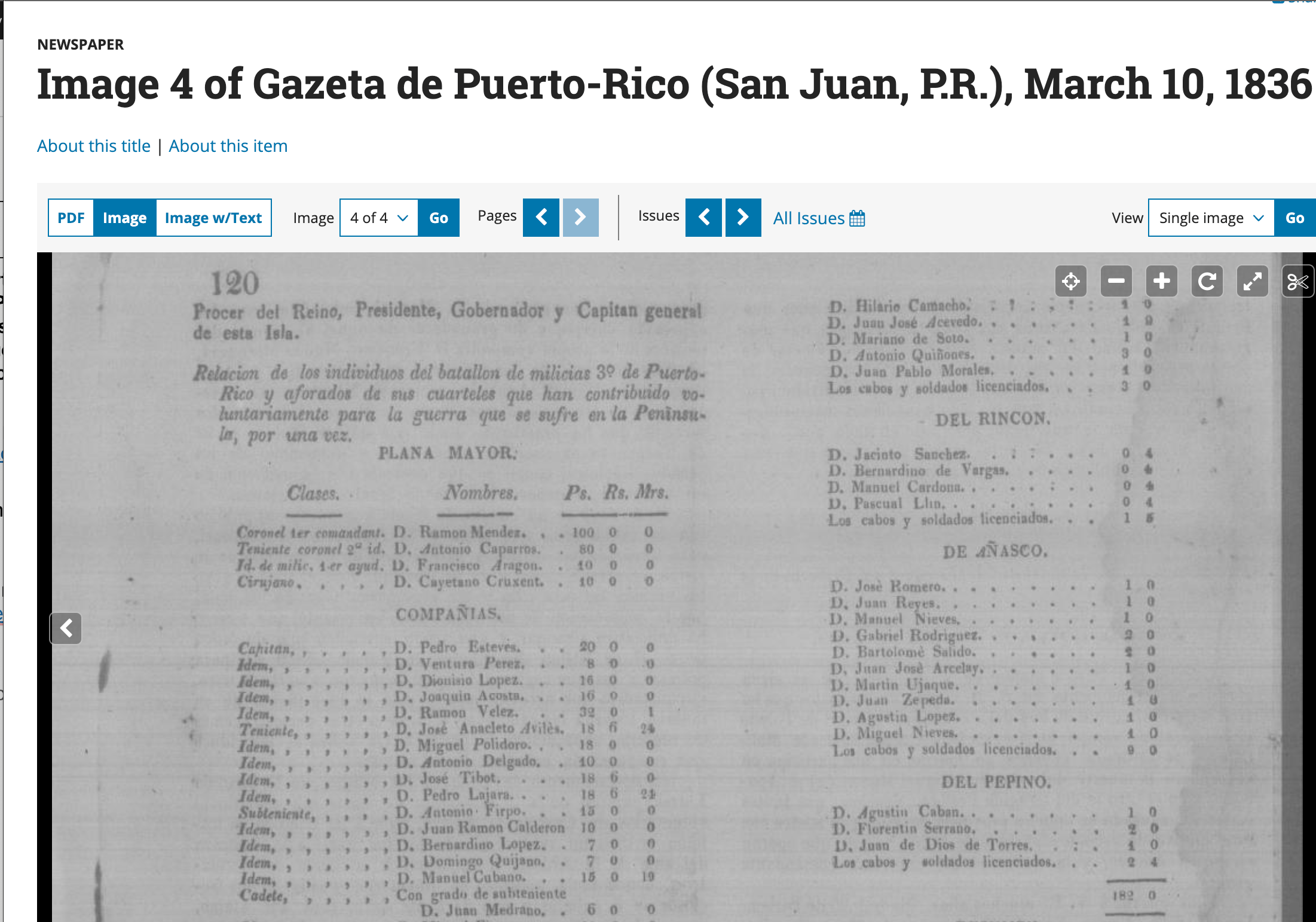
There is one issue, one page, and a finite list of names and towns. Here is how to analyze this record step by step:
- Transcribe the heading and administrative terminology exactly as printed. Note terms like aforados, cuarteles, and plana mayor without modernizing the spelling.
- Consult a nineteenth-century Spanish legal or military dictionary. Colonial terms such as aforado (someone holding a special legal or tax privilege/jurisdiction under military fuero) do not carry the same meaning in modern dictionaries.
- Map the municipalities and evaluate the military unit. Look at the geographical distribution of the 3rd Militia Battalion (batallón de milicias 3º). Were these coastal defense forces? How were local units organized across neighboring towns like Rincón and Añasco?
- Follow two or three listed individuals into local church and notarial records. Check whether these men appear with military titles, specific landholdings, or distinct social standing in contemporaneous parish registers or notarial protocols.
- Evaluate the nature of the contribution. Determine whether a “voluntary contribution” (contribución voluntaria) during the First Carlist War was purely optional, or if social and military pressure made it expected for men of specific standing
The issue is at the Library of Congress and linked below. I will do my best in the next few months to “solve” the puzzle. If you solve the puzzle, please let me know. I would love to publish what you find.
FamilySearch May Publish Images Before You Hear About Them
The second half of our roundtable focused on a gap many researchers do not know is there.
FamilySearch has been digitizing Puerto Rican material, and it can make image groups available before they index or widely publicize them. If you wait for a collection announcement or a searchable name index, you may miss records that you can already browse. It can make image groups available before they index or widely publicize them
How to Check for New Puerto Rican Images
Bookmark the FamilySearch image search filtered to Puerto Rico. I suggest checking it about once a month, much as you would check a favorite bookstore’s new arrivals.
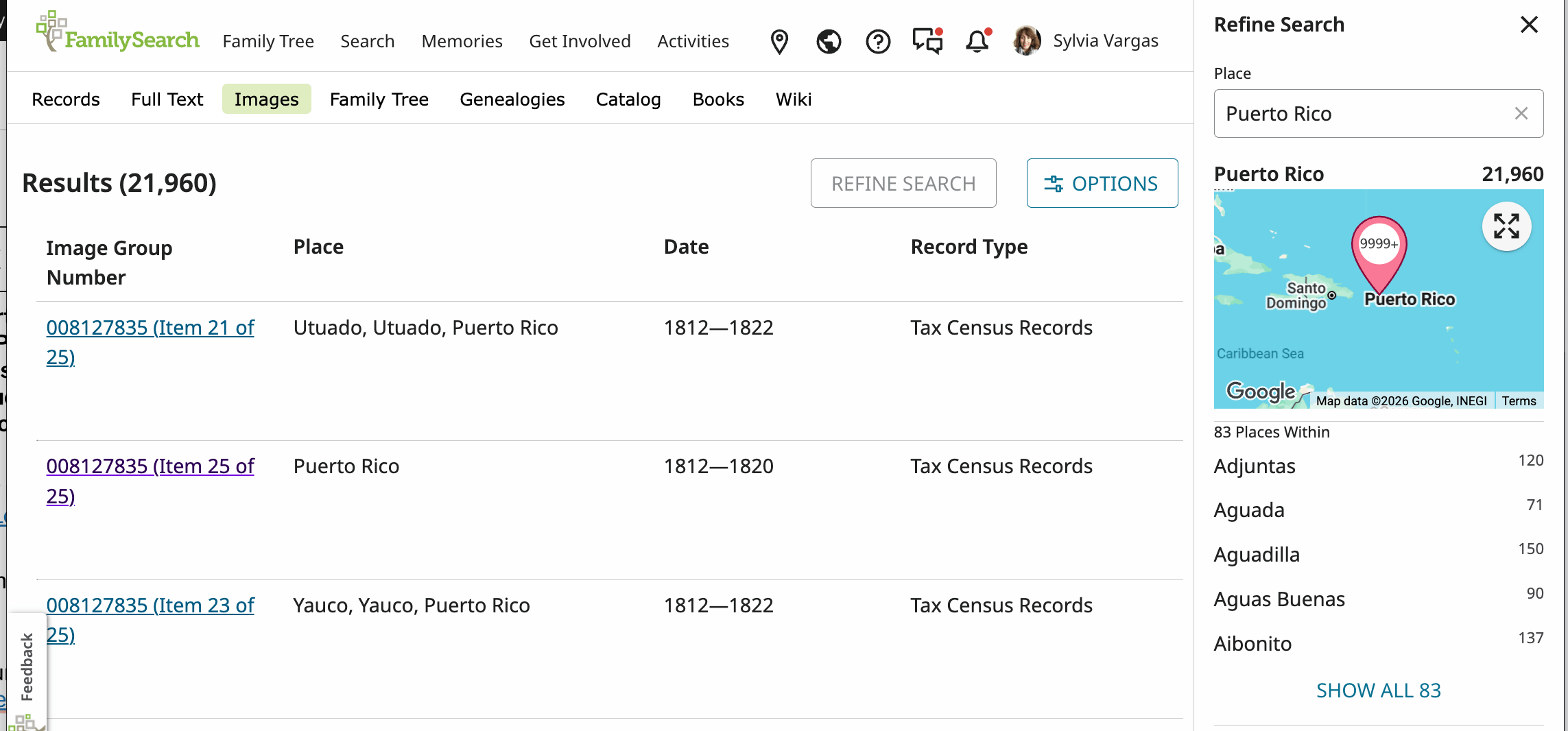
When you visit:
- Sign in to your free FamilySearch account if prompted.
- Open the Puerto Rico image-search link below.
- Narrow the results by place, record type, or date when those filters are available.
- Open promising image groups and read their catalog descriptions carefully.
- Note the image-group title, dates, municipality, and URL in your research log.
- Browse the first images for an internal index, alphabetical section, volume title, or date break before reading page by page.
- Save a citation and image number for anything you find; a copied link alone may not preserve enough context.
Do not be discouraged when a name search is unavailable. These are often unindexed images. You browse them much as you would browse a microfilm reel.
That is the trade: more work now in exchange for access to material that may not become name-searchable for years.
Two categories are especially worth knowing about.
Cabildo Minutes
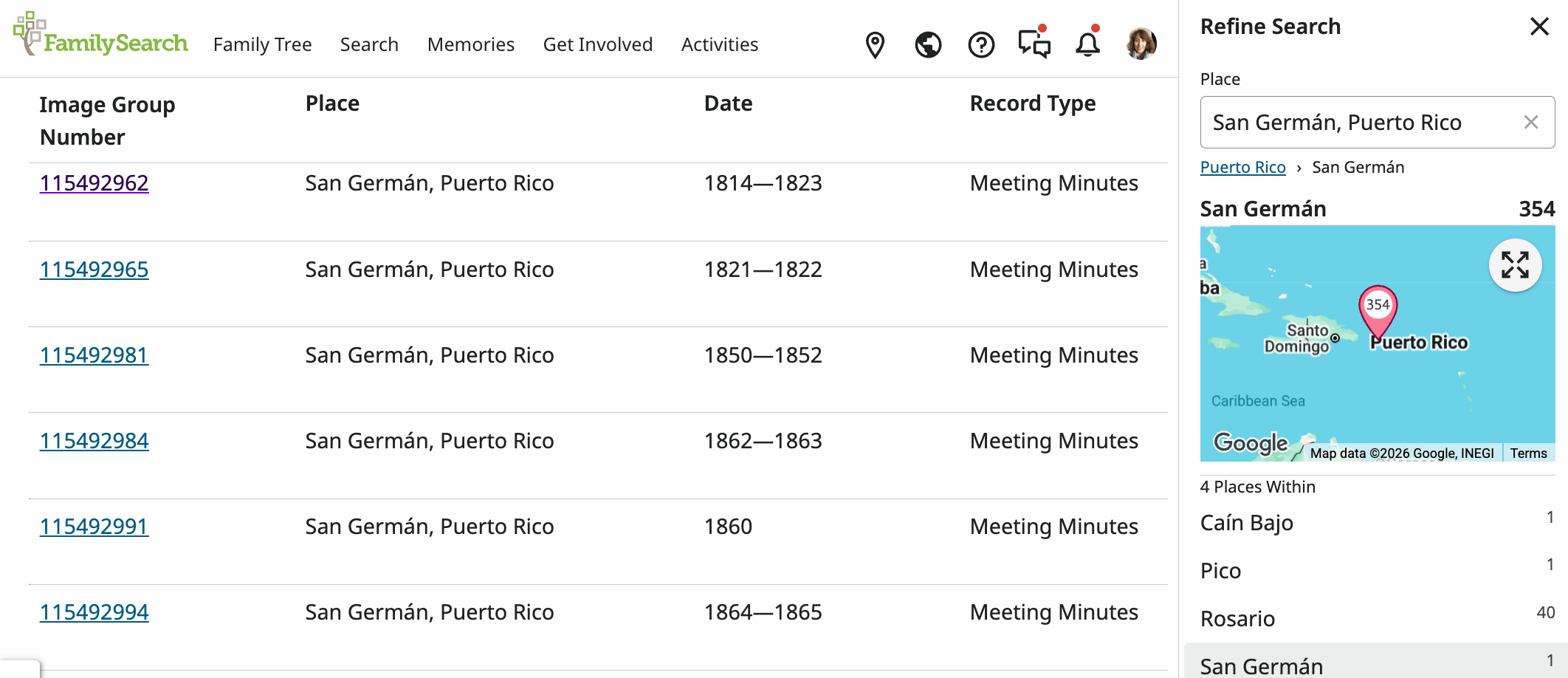
Cabildo minutes document the work of a municipal council, the body involved in governing a town. Records labeled as municipal or council minutes may preserve the business handled by that town’s cabildo. Minutes for San Germán are also available.
These are not vital records, and they probably will not hand you a birth date. They provide the civic details of a town: office holders, petition submitters, appointees, and those involved in disputes over local issues.
They may also mention people who are difficult to find in church or civil records because their surviving paper trail resulted from interacting with local government.
Tax and Wealth Censuses
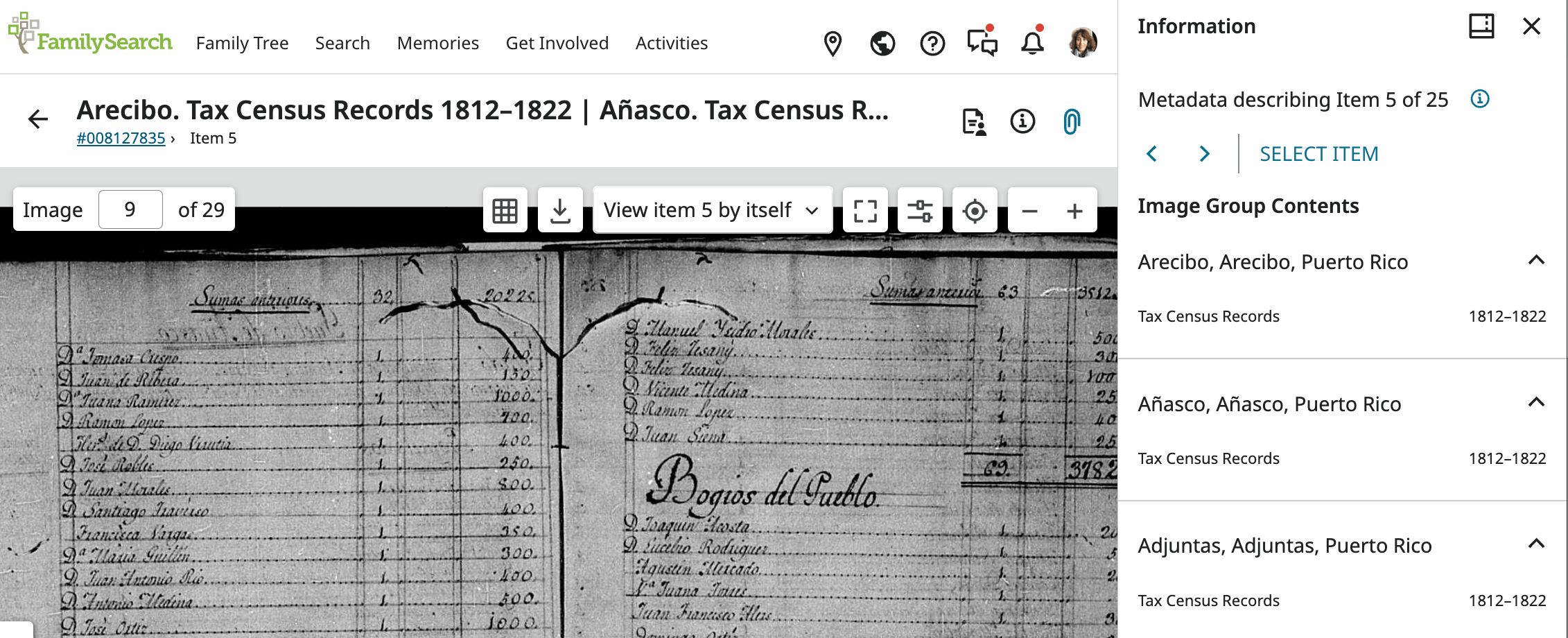
The Censos de Riquezas, or wealth censuses, are another valuable category. FamilySearch has these for Coamo, along with tax census records for Arecibo covering 1812 to 1822 and for Añasco.
These records name property holders and describe what was assessed. That makes them especially useful in the period before civil registration began in Puerto Rico in 1885, when surviving parish coverage can be uneven and access to some records may be limited.
A tax census can place a person or household in a specific municipality in a specific year when no vital record survives to do it. Property details may also help you distinguish between people with the same name living in the same town.
Read tax records alongside electores rosters, but do not assume that one automatically explains the other. The tax record tells you what was assessed. The electoral law and roster tell you whether a person qualified under the rules in force.
My Challenge to You This Month
This month, I would like you to try something different: choose one municipality, not one ancestor.
Pick the town your family is most firmly connected to and give it thirty focused minutes.
Open the Gaceta at the Library of Congress. Search the municipality instead of a surname. Read the results without deciding in advance what you hope to find, and write down every kind of list or notice you discover.
Then open the FamilySearch image search for Puerto Rico. Check what is available for the same town. Even if there is no name index, open one promising image group and browse far enough to understand how it is organized.
You may not find your ancestor in those thirty minutes. You will learn what people were writing down about the place where your family lived—and which of those records survived.
That is something a name search can never tell you. And it may be just what helps you decide where to look next.
When you try it, I would love to hear what town you chose and what unexpected record you found.
Links
Here is everything referenced above:
- Gaceta de Puerto Rico, March 10, 1836 (Library of Congress), the issue with the special-status list: loc.gov
- FamilySearch, Puerto Rico image search, the page to watch for newly digitized material: familysearch.org
- Cabildo minutes, San Germán: familysearch.org
- Censos de Riquezas, Coamo: familysearch.org
- Tax census records, Arecibo (1812 to 1822) and Añasco: familysearch.org
If you want the wider picture of what is online, I wrote a guide to the digitized Puerto Rican newspapers and where to search each one: Looking for Ancestors in Historical Puerto Rican Newspapers.
My thanks to everyone who joined the July roundtable. The best techniques in this post came from the group, not from me.
Want to join us for our next Puerto Rican Genealogy meeting?
Check out https://puertoricangenealogy.org/meetings/. The site provides the list of meeting dates and how to register for the Zoom call.
Discover more from Looking For My Roots
Subscribe to get the latest posts sent to your email.

Leave a Reply